

Did you know that most of the errors in linear equations occur not in the calculation itself, but in the expansion of the parenthesis with a negative coefficient? That’s exactly what you’re going to see today. Do you dare to do it?
Before you start calculating, give your brain a clear signal: we’re working hard now. Mathematical equations are one of those tasks that you can’t turn off – every step either fits or it doesn’t, and the brain only knows it at the very end. But here’s the interesting thing: learning research shows that people who make a habit of commenting aloud or in writing on each step when solving equations make significantly fewer errors than those who calculate silently and quickly. It’s called “verbalising the process” and it helps the brain keep control of what it’s doing. Try it – and see the difference.
What’s coming up today?
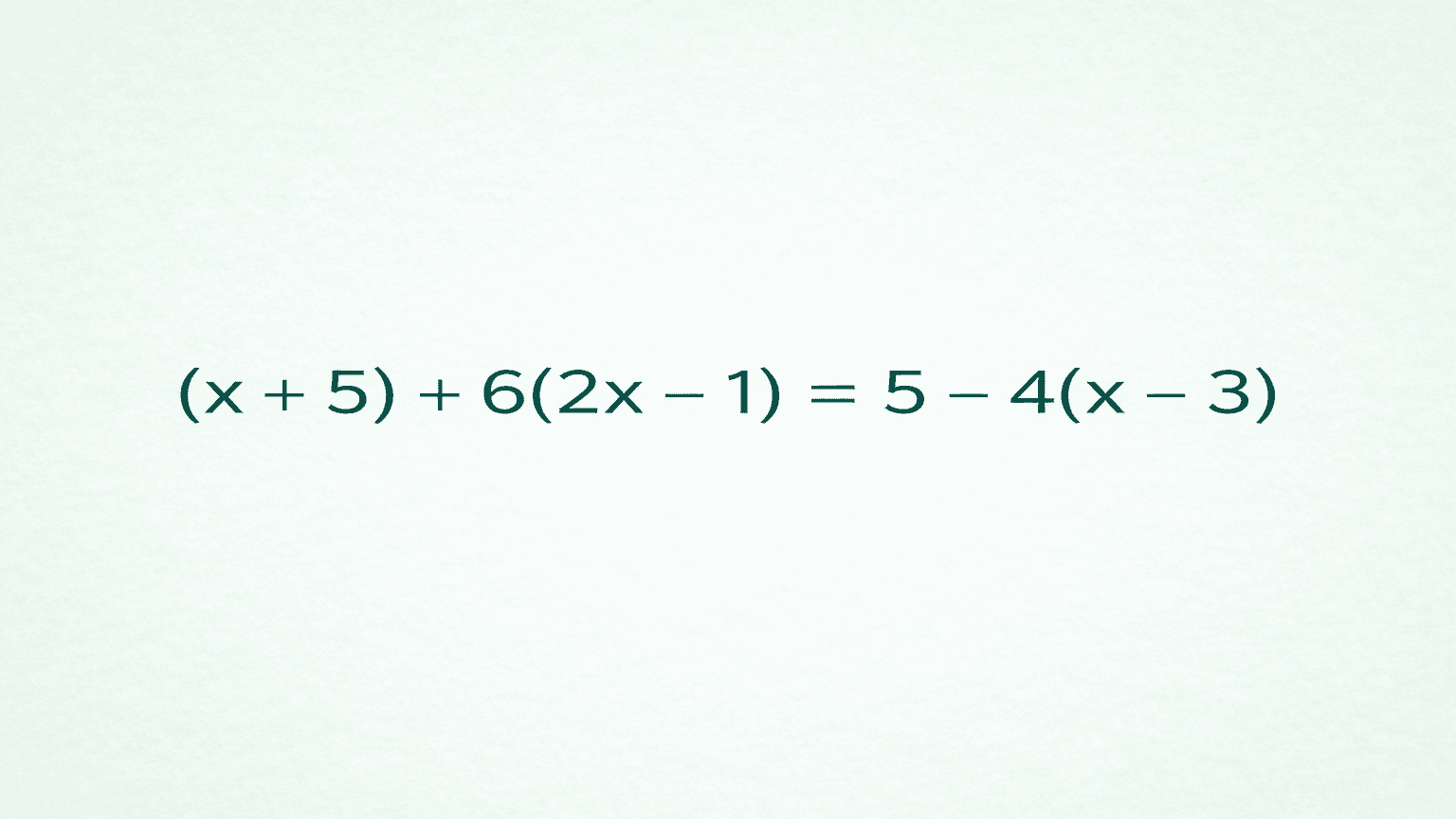
In the picture you will find the equation: (x + 5) + 6(2x – 1) = 5 – 4(x – 3). Your only task is to find the value of x. How to do that is up to you. Take a pencil and paper and do as you were taught at school. Remember that most mistakes are made when removing brackets.
 ━━ Calculate the example.
( Source: Shutterstock )
The correct solution
How did you do? Did you manage to treat the negative bracket on the right correctly? Now is your chance to check your result.
The correct result is x = 18/17.
Develop: x + 5 + 12x – 6 = 5 – 4x + 12. Simplify both sides: 13x – 1 = 17 – 4x. Convert the variables: 13x + 4x = 17 + 1, so 17x = 18. Result: x = 18/17.
The fraction with the number 17 in the denominator will surprise almost everyone – 17 does not appear anywhere in the equation directly, it is formed only by combining all the terms with x. Anyone who made a mistake has most likely misplaced the right parenthesis: -4 times (-3) must give +12, not -12.
Send this equation to friends or colleagues and bet on who can correctly treat the negative bracket on the right-hand side without a single mistake. Regular practice of such problems subtly but demonstrably improves concentration, strengthens the ability to think sequentially, and keeps the brain fit for the long term.
More equations, puzzles and IQ challenges await you on our website – come and test your limits.


 Šárka Cvrkalová

 L. Novak




 A. Urban