


Mathematics can often be trickier than it first appears. A simple equation with a few parentheses can quickly turn confidence into doubt. See for yourself if you can do this example without a calculator.
Many people feel a slight nervousness at the word “equation”. And no wonder – we may know the basics of algebra from school, but once parentheses, signs and unknowns come into play, things get complicated. But it’s problems like these that are among the best training for logical thinking. They teach you to focus on details, to proceed systematically and not to jump to conclusions.
What’s in store for you today?
You have the equation: 5(x-2)-3 = 4x+7(x+1). Your task is clear – modify it to simplify it and find the relationship between the variables x and y. It looks complicated at first, doesn’t it? But try following it step by step: first, multiply the parentheses, then group similar terms, and finally, modify the equation.
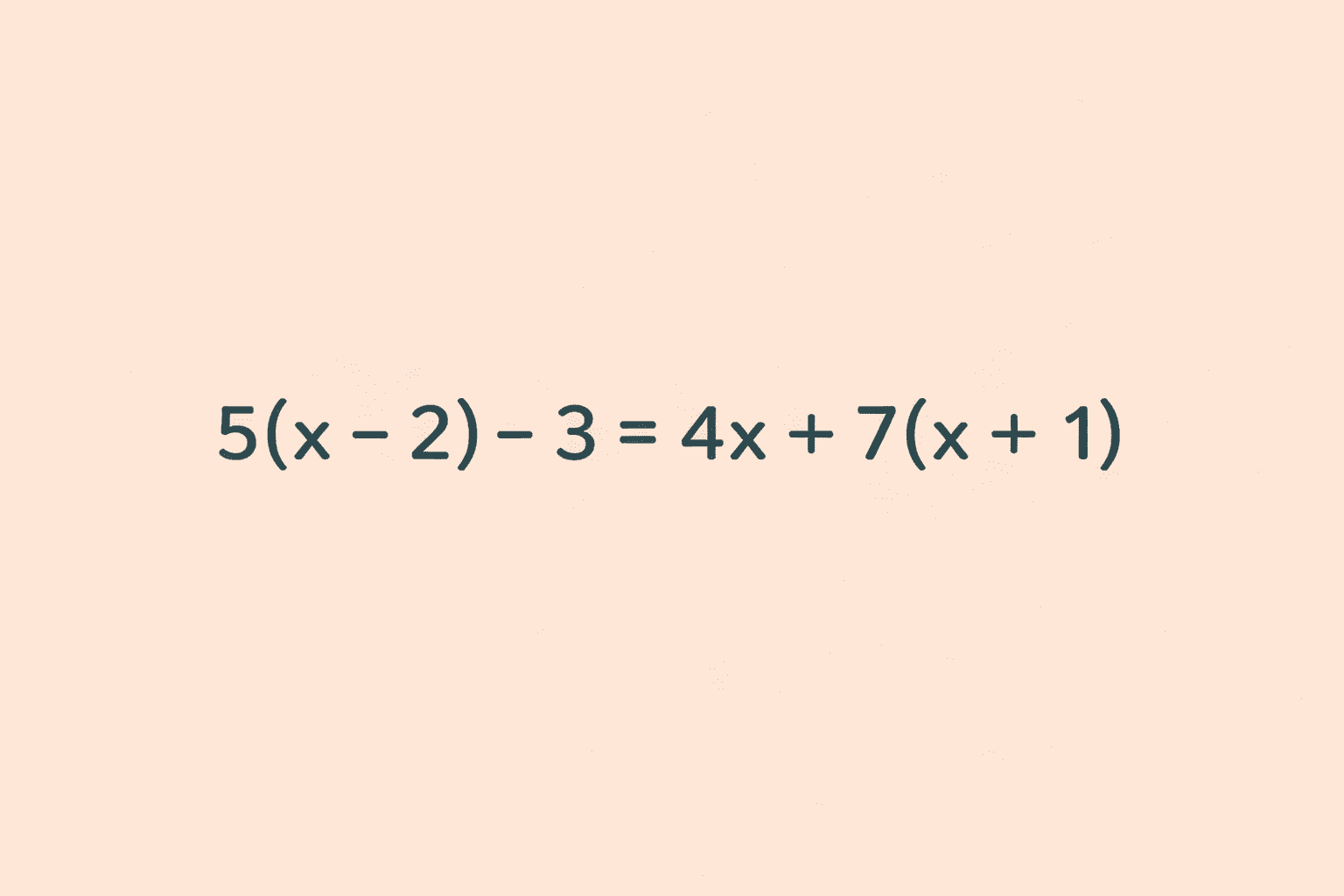 ━━ Calculate the example.
( Source: Shutterstock )
The correct solution
Were you able to arrive at the correct result? You can check below.
The correct answer is x = -10/3.
The procedure looks like this: First multiply the parentheses to get 5x – 10 – 3 = 4x + 7x + 7, which after adjusting the left side gives 5x – 13 = 11x + 7. Now subtract 5x from both sides: -13 = 6x + 7. Subtract 7: -20 = 6x. Finally, divide by six: x = -20/6, so x = -10/3. If you come to a different result, check each step – the error is often in the small details.
Did you get it right on your first try? Then be sure to try sending this equation on – to friends, family or work colleagues. See how many of them can handle it without a calculator. Such a mental exercise is not just a fun walk through the world of numbers, but also an effective way to keep your mind sharp and strengthen your concentration. Fancy more challenges like this? Browse through our collection of logic puzzles and IQ tests – you’ll find dozens of challenges that are guaranteed to keep you on your toes.


 Šárka Cvrkalová

 L. Novak




 A. Urban