

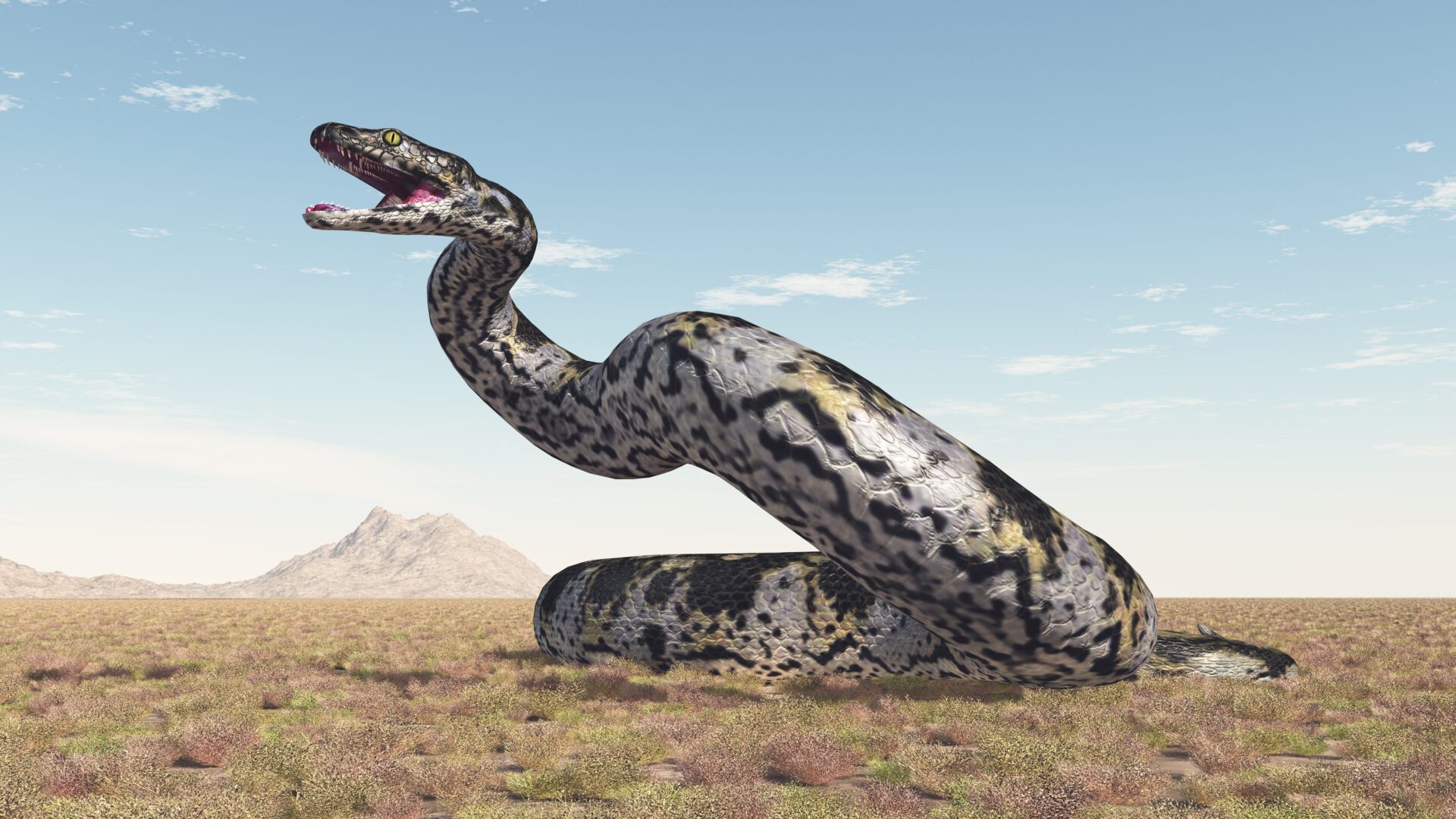
Are you afraid of snakes? If you’ve considered them almost harmless until now, you might change your mind. Millions of years ago, the Titanoboa snake lived on the planet. Paleontologists have discovered what its length was and what it ate.
Throughout the evolution of the planet, there have been creatures whose size exceeds our imagination. One of them was the Titanoboa snake, which grew to record size and could catch crocodiles. It lived some 58-60 million years ago in the tropical forests of what is now Colombia. If it were still alive, it would pose a significant threat to humans.
It ate crocodiles like a raspberry
Anyone with a phobia of snakes would probably faint or go into shock at the sight of a Titanobo. It was 12-15 metres long , up to 2 metres wide and apparently weighed up to 1.1 tonnes. It even surpassed the reticulated python, which measured around 10 metres long and was considered the largest snake until its discovery. Thanks to its size, it was able to catch large animals, especially prehistoric crocodiles, which differed greatly from today’s species. Some were up to 7 metres long. But they didn’t stand a chance against the big snake. Its green scaly body and jungle environment allowed it to camouflage itself easily and attack its prey at a moment’s notice. Fossil finds confirm that he trapped his victims with a strong grip, probably exerting pressure in excess of 180 kilograms per square centimetre.
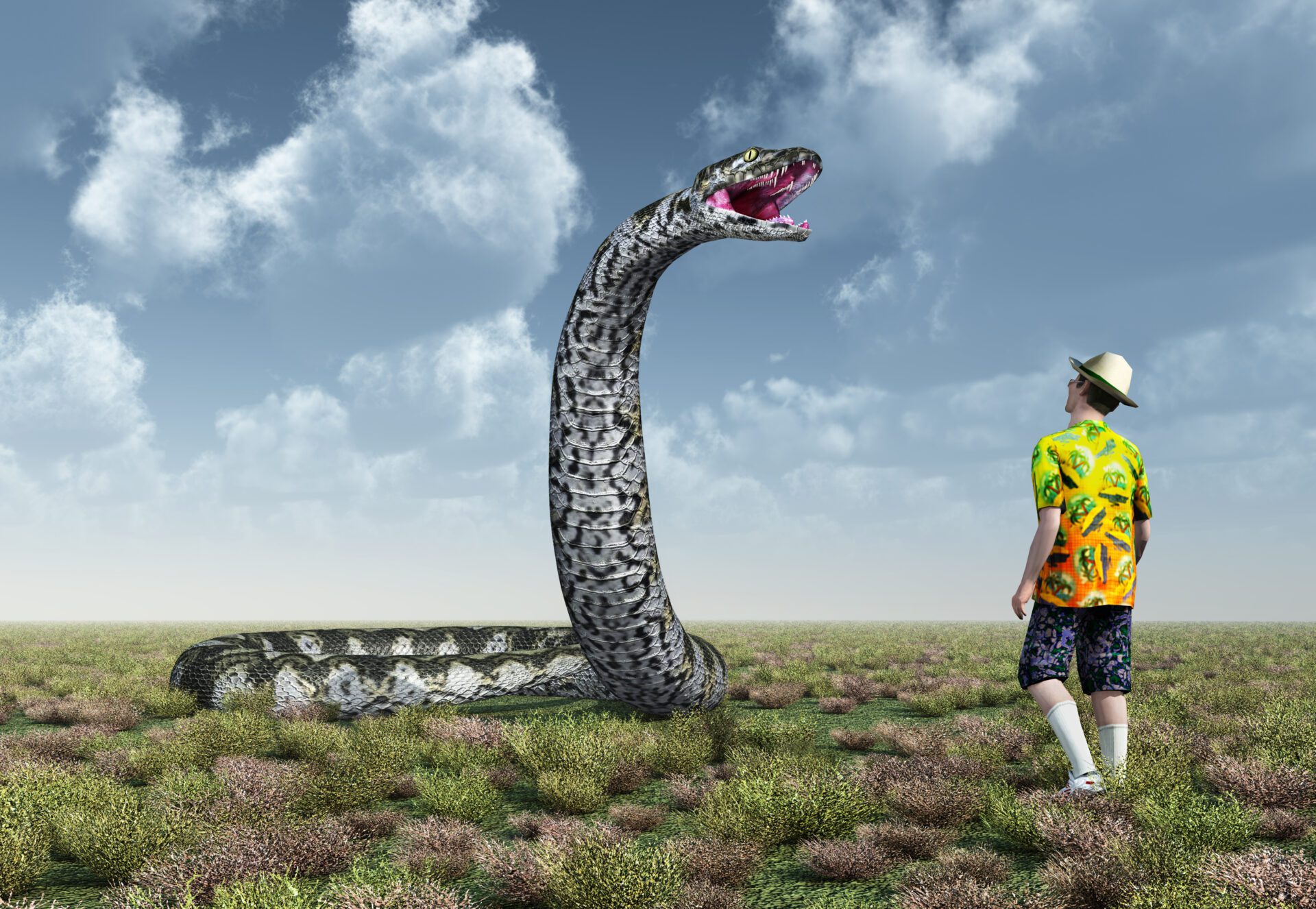 ━━ If Titanoboa were alive today, it would be a great threat to humans.
( Source: Michael Rosskothen / Shutterstock )
The existence of Titanoboa snakes was confirmed in 2009 thanks to findings in the Cerrejón coal mine in northern Colombia. The team of North American scientists was led by Jason Head, who worked at the University of Toronto. After the surprising discovery, he noted that the snake was unmatched in size at the time. “After the extinction of the dinosaurs, this animal, Titanoboa, was the largest predator on the surface of the planet for at least 10 million years. It was a significant animal in any sense of our imagination,” said Jonathan Bloch, an expert on vertebrate evolution at the University of Florida.
The warm climate influenced the size
Experts said its size gives us information about what the climate was like back then. Since it was much larger than other animals, the climate must have been warm. Tropical rainforests probably had an average annual temperature of 30-34°C. It was a cold-blooded reptile and therefore would probably not survive in today’s conditions.
“We think Titanoboa became so large because it was much warmer at the equator after the dinosaurs went extinct 60 million years ago. That’s why we think reptiles were generally bigger,” Bloch continued.
Could it come back to life again?
Climate change has contributed to Titanoboa’s enormous size, so scientists are being asked questions about its possible return. As global warming increases, temperatures are rising again, so theoretically a new Titanoboa could be born. “As the temperature rises, it is likely to return. However, the development of a new species requires geological time. It could take a million years – but maybe it will happen!” added Carlos Jaramillo, a member of the team.
So for the time being, we don’t have to worry about encountering this monster in the jungle. However, the discovery of its existence gives us a glimpse into the Paleocene epoch and provides a picture of the climate and reptile evolution at that time.


 Šárka Cvrkalová

 L. Novak



 O. Müller
