


Equations with multiple brackets on both sides of the equation need a systematic approach and precision. Today’s example will take you through a situation where you have to keep track of every multiplication and all the conversions of the terms to arrive at the correct number in the end.
Have a pencil and paper ready because this is not a guessing problem. Mathematical examples with multiple brackets require a methodical approach and patience with each step. It is the systematic approach that distinguishes those who feel confident with numbers from those who get lost in the middle of a calculation. Today’s equations are among those that look scarier than they actually are – you just have to keep your thoughts organized and follow them step by step.
What’s in store for you today?
The equation in front of you is 5(4x + 3) – 2(2x – 7) = 6 – 3(3x + 1). The challenge is to calculate the value of the unknown x. There are parentheses on both sides of the equation, which you must first multiply, then adjust, and only then follow the clearly given rules. It is this sequence of steps that determines the success or failure of the final result.
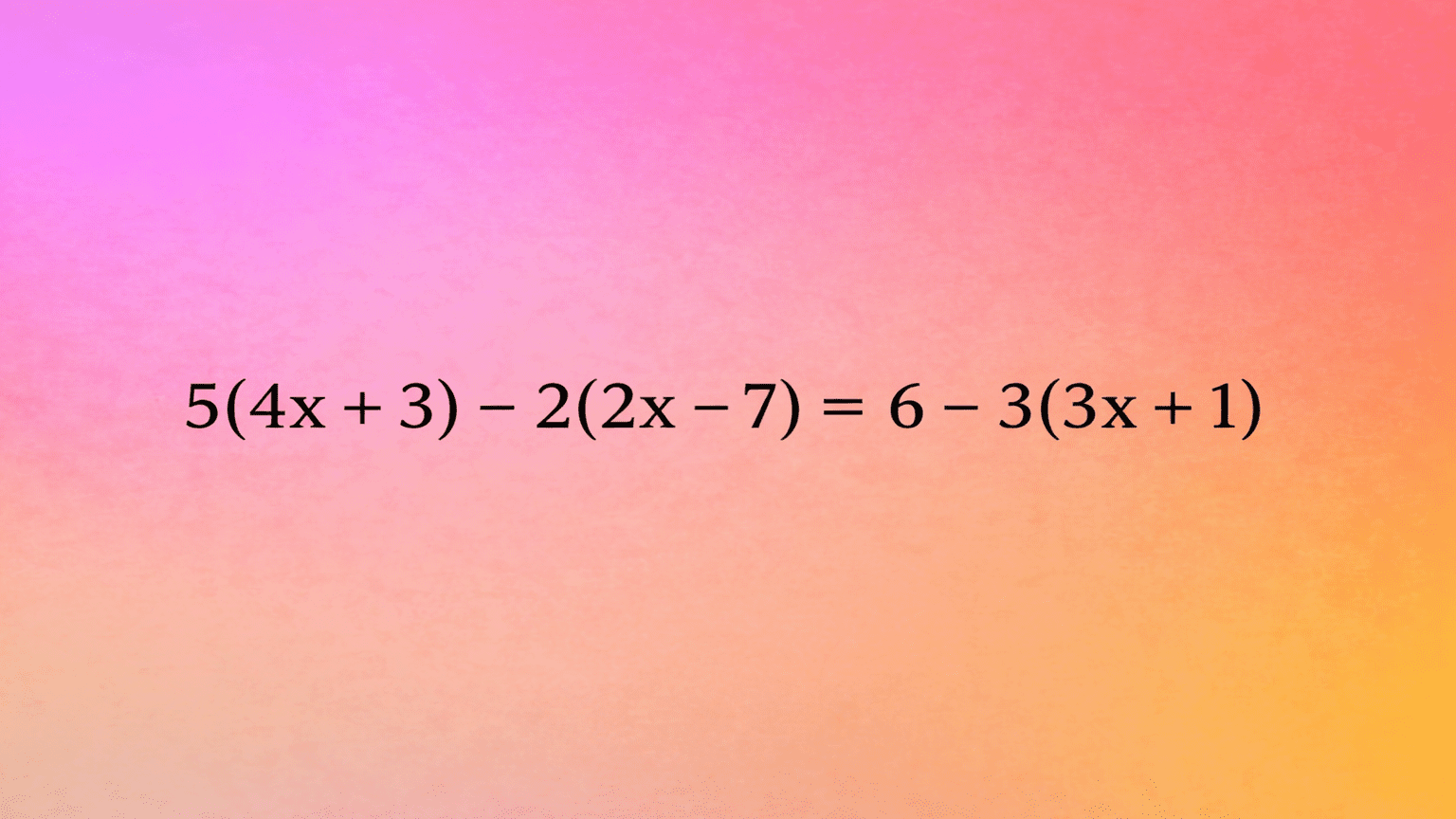 ━━ Calculate the example.
( Source: Shutterstock )
The correct solution
Did you do it without hesitation? Did you arrive at the correct result? Let’s take a look at the whole procedure now.
The correct value of x is -26/25, which is approximately -1.04.
The procedure looks like this: first, multiply all the parentheses. On the left hand side we get 20x + 15 – 4x + 14, which after adjustment gives 16x + 29. On the right hand side we have 6 – 9x – 3, so 3 – 9x. The whole equation then looks like: 16x + 29 = 3 – 9x. Let’s convert the terms with x to the left and the numbers to the right: 16x + 9x = 3 – 29, so 25x = -26. After dividing, we get the final result x = -26/25.
Such mathematical nuts are worth sending on. Try your family or colleagues and see who comes to the correct result the fastest. Regularly solving similar problems has been shown to improve concentration and strengthen analytical skills. If you enjoyed this example, we have more tests and logic puzzles that will definitely not leave you bored.


 Šárka Cvrkalová

 L. Novak




 A. Urban