

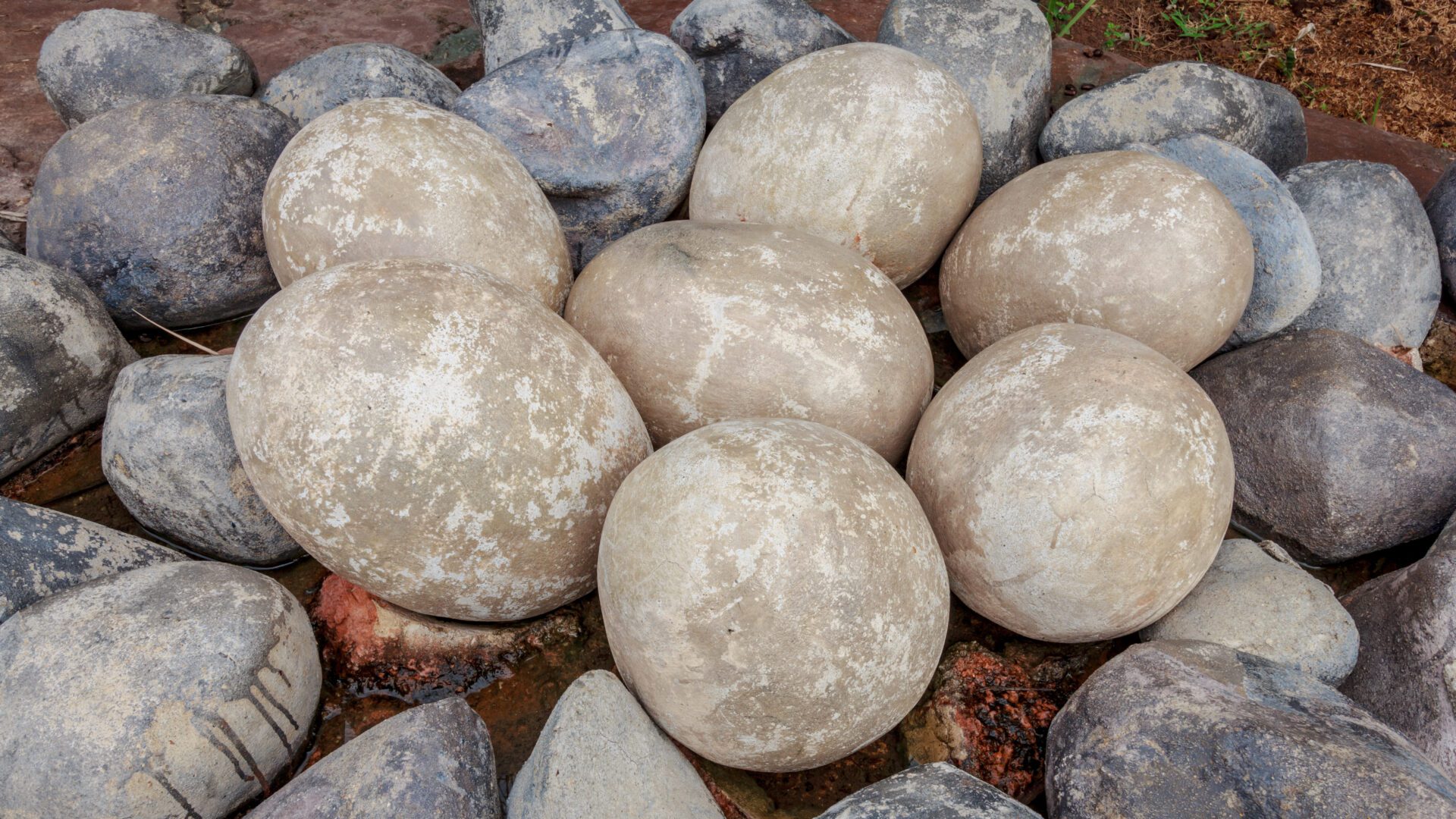
It is called “the mountain that lays eggs”. Its official name is Mount Gandeng. Many people claim that it is a miraculous place where supernatural things happen. The name makes it clear why. The mountain, according to some people, lays eggs. Well, not literally. However, once every 30 years or so, a smooth, oval-shaped rock falls from the mountain, resembling a perfect egg. And the origin of these stones is not fully explained.
The smooth stones with their fine surface, oval shape and dark blue hue are usually about 20 to 60 centimetres in diameter. Some of them weigh up to 300 kilograms. Yet at first glance, they resemble perfect eggs. For scientists, it’s a fascinating phenomenon. They find the stones interesting not only because of their perfect and regular shape, but also because of their surface and composition.
The deep cultural significance
The village of Gulu Zhai, which lies at the foot of the mountain, regards the mountain as a literally sacred place. The stone eggs have deep cultural significance for the local people. They believe that they bring them good luck, protect them from danger, and signify prosperity and peace.
Most households in the village own at least one egg. Whenever a new one appears, there is a great demand for it. Some families even have several stones in their homes, and the more they own, the greater the chances of a happy and long life for all family members, they believe.
The legend of the mountain that lays the egg has been passed down from generation to generation for hundreds of years. Some people go to the mountain to pray, there are several important places that are said to bring people energy and where some spend long hours a day just to ensure a happy life.
What does the science say?
Although scientists are confused about the shape of the stones and the general fact that they only appear once every few decades, geology has recently come up with a rational explanation. The mountain’s cliff is made of limestone sedimentary rock. It contains harder sediments that are more resistant to erosion.
As the softer layers gradually erode, the egg-shaped rocks remain protruding until they eventually break loose and fall down. However, the exact cause of the formation of their shape, smooth surface and regular timing remains a matter of debate.
The phenomenon is fascinating to many, both ordinary people, those living at the foot of the mountain, and scientists, who, while understanding part of the origin of the eggs, are unable to explain much of it. Moreover, the regularity with which the stones appear is almost miraculous and many believe that it is therefore literally a supernatural force that is influencing nature in the area.



 L. Novak



 O. Müller

 A. Urban