


How does it feel and what does a person who is on the verge of death experience? This is a question that worries scientists, doctors, and ordinary people. The boundary between the world of the living and the dead carries an aura of mystery, so it is no wonder that everyone is interested in what happens in the last hours of life. Modern research has given some insight into this area. But it’s safe to say that the senses are gradually fading.
Advances in medicine are more noticeable now than ever before. New treatments and procedures are being developed, new modern devices are being introduced into the process, and much research is helping to understand why diseases arise and offering innovative ways to treat them. But science is short on death. Sometimes it comes suddenly, in the case of palliative treatment, gradually. And it is at these moments that scientists can study, at least marginally, the process of dying itself. Recent findings reveal that in the last hours of life, the senses gradually die.
First, the sense of hunger disappears
There are many testimonies of people sharing their near-death experiences, or experiences of being close to a dying person. This knowledge makes it easier to understand what is happening to the body. James Hallenbeck, a palliative care physician at Stanford University, states that people lose their senses in an unalterable order. First they lose their sense of hunger and thirst, followed by speech, sight and, in the last stage, hearing and touch.
David Hovda, director of the UCLA Brain Injury Research Center, explains this process simply: “The brain initiates a process in which areas that are less important for survival are sacrificed.”
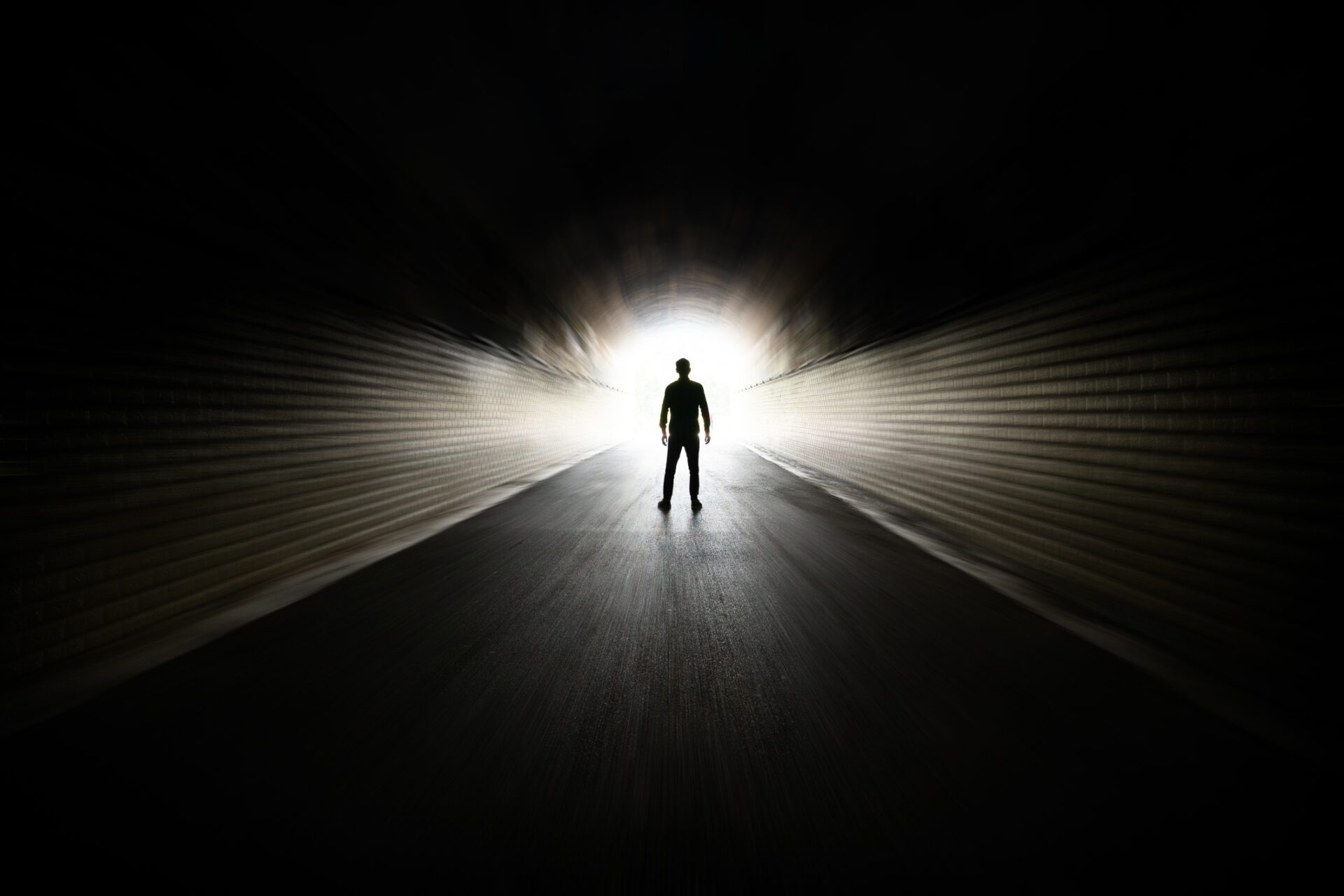 ━━ People who have almost died talk about near-death experiences. They agree that they saw the light at the end of the tunnel.
( Source: xijian / iStockphoto )
Light in the tunnel: Do they really see it?
People who have found themselves on the threshold of life and death often talk about the tunnel and the light at the end of it. However, this is not a fantasy image, but a brain reaction. “When the brain starts to change and die, different parts are stimulated, and one of the parts stimulated is the visual system,” explains David Hovda, director of the UCLA Brain Injury Research Center. It’s at this point that most people see a glowing light. These individuals also report that they had interesting experiences in their minds before they regained consciousness. The connection could be in the process of increasing neurochemicals in the brain that is related to hallucinogenic reactions.
The moment a person stops eating and loses their sight, they enter this strange phase that is difficult to explore and understand. “From this point on, we can only guess what is actually happening. I have the feeling that this is not a coma, a state of unconsciousness, as many families and doctors think, but something like a dream state,” Hallenbeck further reflects.
Life flashes before your eyes
A number of survivors also talk about the sequence of life events that passed before their eyes. The anecdote “my whole life flashed before my eyes” is often uttered between speeches, but anyone who has actually experienced such moments understands the true meaning.
“People have been reporting episodes of paradoxical lucidity and heightened consciousness in relation to death for decades. This is interesting because it seems to occur in areas of the brain that shut down in the context of death,” says Dr. Sam Parnia. As studies confirm, during the phase when the human body is on the cusp of life and death, brain wave changes occur that affect important cognitive functions. The brain then becomes actively involved in recalling various moments hidden in memory. This happens at the moment when it “switches off”.
For the time being, however, it is not possible to clearly specify what happens just before death. However, thanks to brain research and near-death experiences, experts are able to at least partially peek under the hood of the mystery of life and death. “Although the mechanisms and physiological significance of these findings have yet to be fully explored, these data show that the dying brain may still be active,” Parnia adds.


 Šárka Cvrkalová

 L. Novak



 O. Müller
